Curriculum
A Journey, Not a Conveyor Belt
At Divyataa, we do not sort children by age and move them along a conveyor belt. We place them in communities that match where they are developmentally, and trust that what they need will find them there.
Why Montessori
Most of us attended schools where the teacher talked and we listened. Where the bell decided when thinking stopped. Where being wrong was something to hide, and curiosity was something to manage. The classroom moved at one pace, and every child was expected to keep up, regardless of where they truly were.
Montessori Method is built on a different understanding entirely. That children are born with a deep, natural drive to learn. That the environment matters as much as the teacher. That mastery comes through doing, through repetition chosen freely, through the particular joy of figuring something out for yourself. This method has been working across cultures, continents, and generations for more than 120 years. It endures because it begins with the child, and it trusts what it finds there.
The Prepared Environment
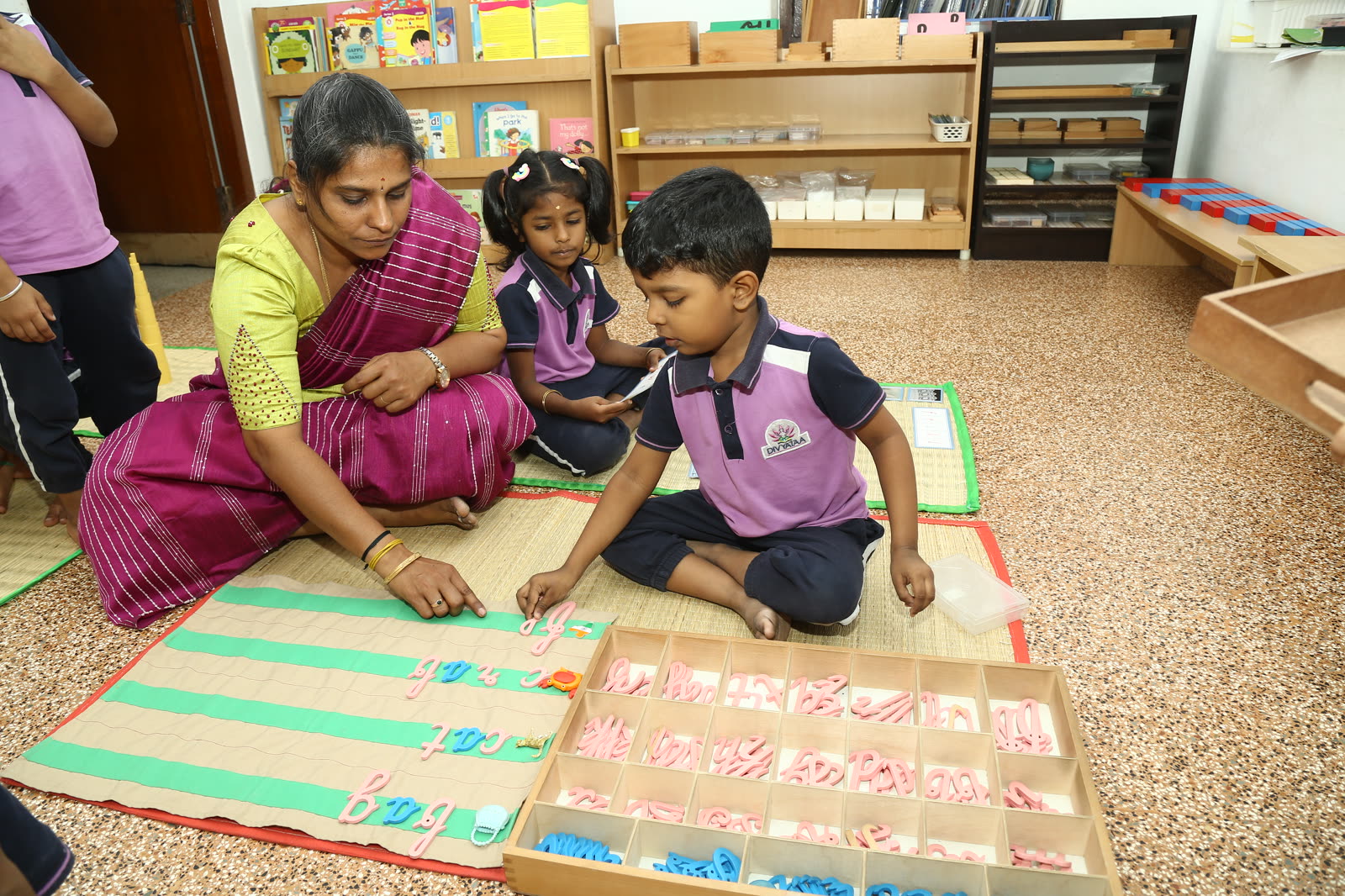
A Montessori classroom is not decorated. It is designed. Every shelf is at child height. Every material has exactly one place. The child moves freely, chooses their work, and discovers what comes next, not because a teacher directed them, but because the room itself invites it. The environment is the first teacher.
Freedom Within Structure
Children at Divyataa choose their own work within clear, understood limits. This is not permissiveness. It is practice, daily exercise of the same capacity that adults spend entire careers trying to develop: the ability to direct themselves.
Mixed-Age Communities
Our classrooms bring together children across a three-year age span. The six-year-old watches the eight-year-old and reaches. The nine-year-old teaches the seven-year-old and, in doing so, understands the concept more deeply than any worksheet could have made possible.
Three Hours of Uninterrupted Work
No bells. No forced transitions every forty minutes. The morning work cycle at Divyataa gives children the rarest gift in modern education: time to go deep. Concentration is not demanded here, it is grown, slowly and steadily, until it becomes a habit so natural the child does not realise they have it.
The Guide, Not the Lecturer
Our educators are trained to observe before they speak. To offer a lesson at the moment the child is ready for it, and then to step back. The goal of a Montessori classroom is one that functions beautifully without the teacher at its centre.
Primary Montessori: Casa
Where independence begins
This is where it all starts. The KG environment is built entirely around the young child's natural drives: to move, to touch, to repeat, to master. Children here do not sit and listen. They work.
"Each morning, a child in the KG environment chooses their activity, carries it to their workspace, completes it, and returns it. This simple cycle builds the habit of beginning, concentrating, finishing, and caring for what belongs to everyone."
Practical Life
Pouring, folding, sweeping, buttoning, transferring, cutting. These are not chores. They are building hand-eye coordination, concentration, and fine motor control.
Sensorial
The pink tower. Colour tablets. Sound cylinders. Before a child can think in abstractions, they must have handled them. Giving the mind precise vocabulary for what the hands have learned.
Language
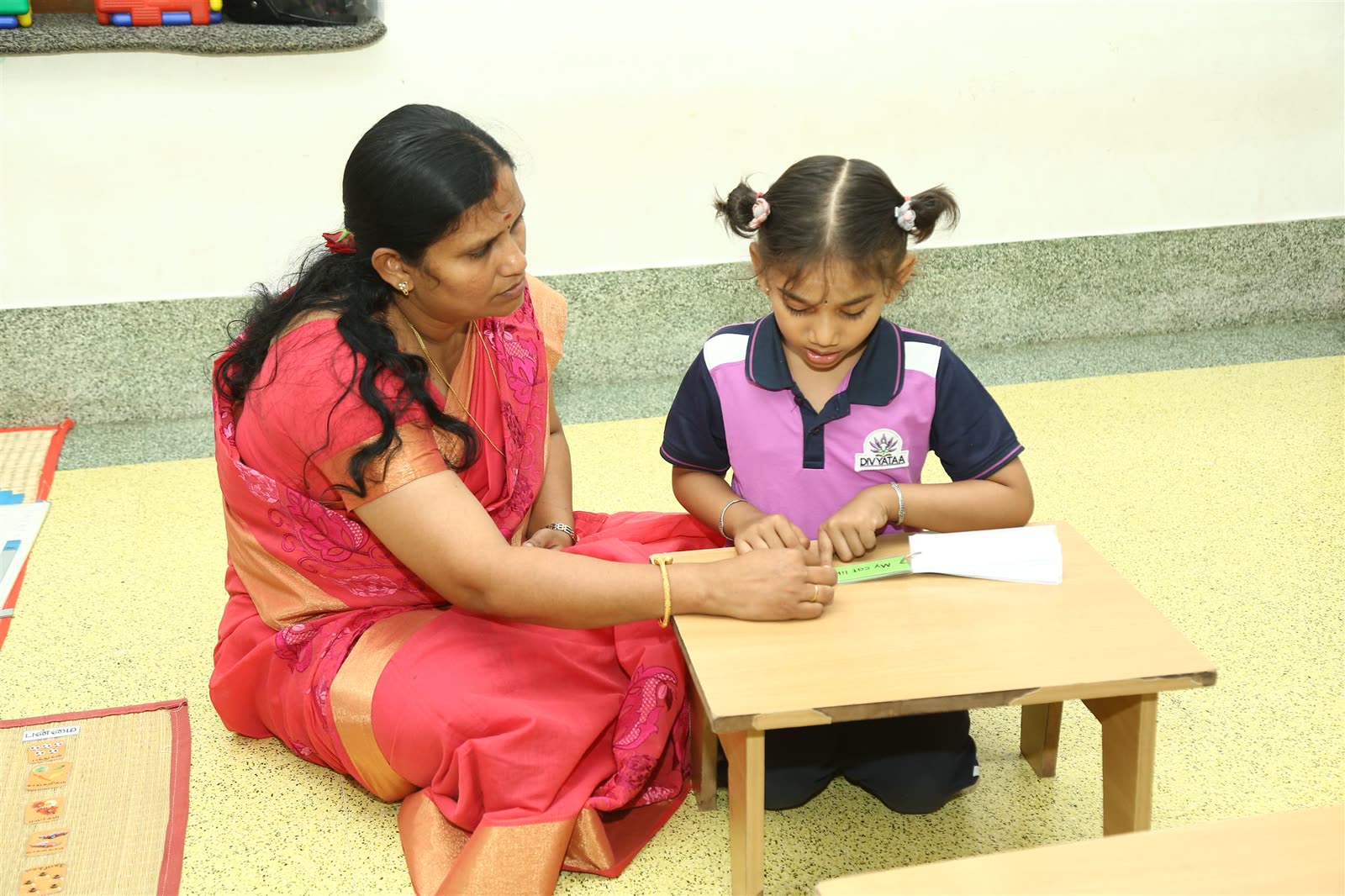
Sandpaper letters. The moveable alphabet. Phonemic awareness. Reading and writing emerge not from drills but from discovery, in a sequence that mirrors natural development.
Mathematics
Golden beads. Bead chains. The stamp game. Physically holding one thousand bead units creates an understanding of place value that never leaves them.
Cultural Studies
First maps. First animals. First plants. First stories of the earth. Planting the seed that the world is large, extraordinary, and worth exploring.
Grace & Courtesy
At Divyataa, children learn how to enter a room, how to interrupt with care, how to offer help and receive it. These are lessons taught through demonstration and practice, woven into the day rather than added onto it. A child who knows how to move through the world with consideration carries that fluency everywhere they go.
Elementary: Curiosity Unleashed
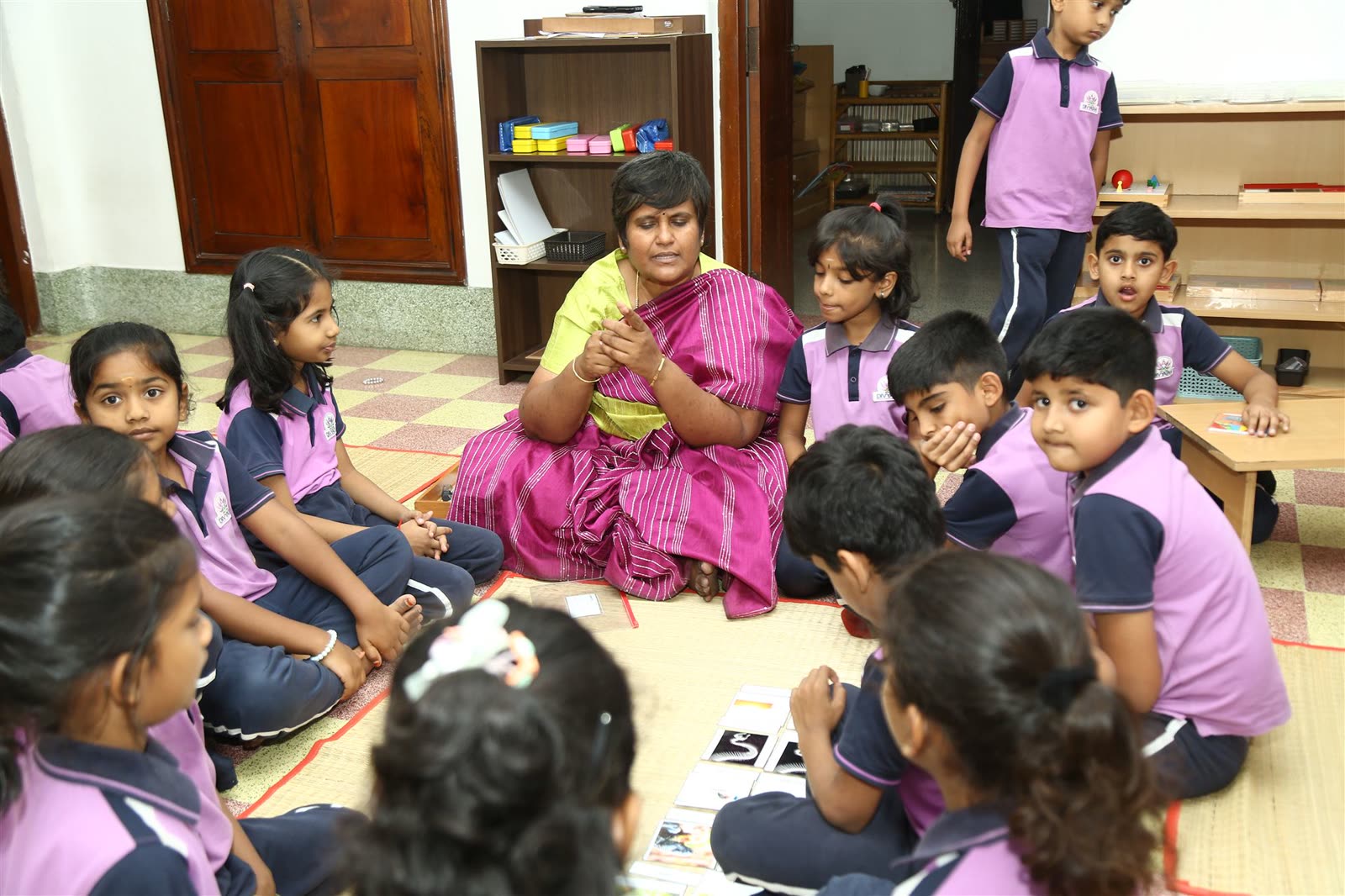
Around age six, something shifts. The child who wanted to touch everything now wants to know why everything. Why did the dinosaurs disappear? Who invented writing and when? The Elementary years at Divyataa are built for exactly this hunger.
The Five Great Lessons
The Story of the Universe: how matter, energy, stars, and planets came to be
The Story of Life: the long slow drama of living things on earth
The Story of Human Beings: how our species found fire, language, and each other
The Story of Writing: from pictograph to alphabet
The Story of Numbers: from tally marks to mathematics
Language Arts
Reading, writing, grammar, composition, research, and storytelling. By Grade 6, children write with clarity and argue with evidence.
Mathematics
Four operations, fractions, decimals, geometry, ratio, and early algebraic thinking, all built from concrete materials.
Cultural Studies
History, geography, botany, zoology, and physical science, studied as a connected whole through timelines of life.
Going Out
Children plan and execute real expeditions to investigate questions they have developed themselves. Research in the truest sense.
Beyond the Classroom
Our co-curricular programme develops the whole child—physically, creatively, culturally, and socially. These are not extras, they extend the curriculum.
Movement and Martial Arts
- Karate
- Silambam
- Yoga
- Sports
Arts and Culture
- Bharatanatyam
- Choir
- Visual Arts & Crafts
Mind and Thinking
- Chess
- Public Speaking
- Project Work
Enrichment
- Whole Brain Integration
- Field Trips
- Nature Study
Take the first step
Every child at Divyataa begins with a school visit, a morning spent watching the children at work, asking every question you have, and seeing whether this is the right fit.
Schedule a Visit